























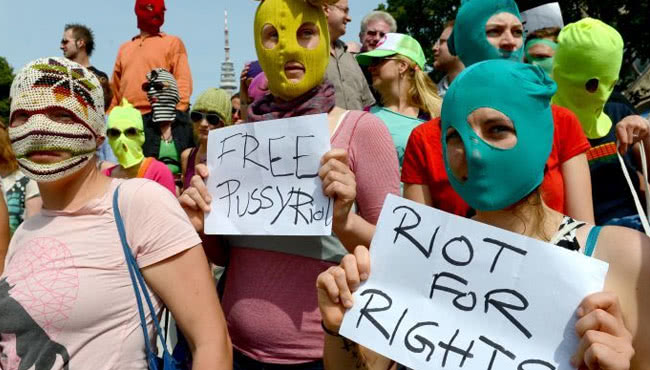
Members of Russia’s punk band Pussy Riot were sentenced to 2 years jail after performing in a Moscow cathedral protesting against the Orthodox Church leader’s support for President Putin. There’s no surprise this blatant act of censorship and restriction of the bands right to express themselves has been met with so much criticism. While we ponder the effect of this complete disregard for artistic expression and political freedom, Tone Deaf looks at a brief history of censorship in popular music.
The Beatles
Allusions to drugs in music are fairly commonplace these days and goes largely unpunished, however it wasn’t always that way. Even one of the most popular bands of all time hasn’t escaped censorship. Both ‘Lucy In The Sky With Diamonds’ and ‘A Day In The Life’, from 1967’s Sgt. Peppers Lonely Hearts Club Band, was banned from BBC radio as they were thought to encourage drug use.

The Sex Pistols
It was the song that launched The Sex Pistols into the spotlight and immediately cemented their place in punk rock folklore. ‘God Save The Queen’ was a very clear anti-establishment message, equating the Queen with “a fascist regime”. The song was released during Queen Elizabeth II’s Silver Jubilee in 1977 and reached #2 in the UK charts. Despite it’s obvious popularity with the masses the BBC refused to play the song, only furthering its success and notoriety.

The Rolling Stones
When playing the Ed Sullivan show in 1966, the famous talk show host convinced Mick Jagger to sing “let’s spend some time together” instead of the original lyric ‘Let’s Spend The Night Together.’ The thought of spending the night was clearly far too risqué for television audiences. The Stones have copped more than most also being forced to change lyrics in ‘Start Me Up’ for their 2006 Super Bowl performance and were forced to drop ‘Brown Sugar’, ‘Honky Tonk Woman’, ‘Let’s Spend The Night Together’, and ‘Beast of Burden’ from their set for the China leg of their 2006 world tour.

Yoko Ono & John Lennon
The 1968 debut for John and Yoko, Unfinished Music No.1: Two Virgins, sparked particular controversy over its cover art. The front cover depicts Lennon and Ono standing next to each other in a black and white photo completely naked, warts and all. On top of the startling front cover, the back cover showed the equally naked rear view. Needless to say it wasn’t well received by distributors who sold the record in a plain brown wrapper as not to offend the sensitive masses.

Billie Holiday
Modern day jazz doesn’t necessarily register with music that would likely to be censored or banned. Billie Holiday’s 1956 version of the Cole Porter song ‘Love For Sale’ was banned by the entire ABC radio network due to is lyrical content about prostitution. Luckily for Porter it was still aired as an instrumental, so the only loser in this affair was most certainly Lady Day.

Bjork
While performing in Shanghai, China in 2008 Bjork certainly ruffled a few feathers. Finishing her set with the controversial tune, ‘Declare Independence’, as the track came to a close Bjork repeatedly yelled ‘Tibet! Tibet!’ referring to China’s 58 year occupation of the region. Suffice to say the Chinese Government weren’t rapt with what they saw and banned Bjork from performing in China as well as stating any artist who engages in similar activity will also be banned.

M.I.A.
If you’ve seen the video clip/short film for M.I.A.’s ‘Born Free’ then it’s likely you’ll understand the controversy surrounding it. It’s certainly not light on violence; in fact it embraces it in a big way, with themes of genocide and racial discrimination. The graphic violence and military brutality was too much for YouTube, which banned the clip in the US and the UK.

Elvis Costello
In 1977 The Sex Pistols were due to perform on Saturday Night Live however visa problems meant the slot went to Costello and The Attractions. Costello wanted to play their hit ‘Radio Radio’, which protests against recording studios and commercial radio stations, however was told to play ‘Less Than Zero’. This didn’t sit too well with the British punk man who stopped the band 8 seconds in and began playing ‘Radio Radio’ instead. The move led to him being banned from the show until 1989, one of only 3 artists to have their SNL ban lifted.

Madonna
Madge has had her fair share of controversy and is certainly not afraid to push the boundaries when it comes to sexuality. MTV were set to premiere the video for ‘Justify My Love’, however the black and white video featured Madge engaging in lewd acts with men, women and even those of questionable gender, not to mention she wasn’t wearing much. This didn’t really tickle the fancy of MTV who banned it immediately.

Dixie Chicks
During a 2003 concert in London, Dixie Chicks singer Natalie Maines stated she was ashamed George W Bush was from Texas. Turns out country radio didn’t agree, with Cumulous Broadcasting banning the band from its 262 stations. Thankfully for the Dixie Chicks there was a Republican talking sense with Senator John McCain stating the conduct of the broadcaster was an erosion of the first amendment.

The Prodigy
Once again it’s the video that saw controversy surround this song. The original uncensored version of the ‘Smack My Bitch Up’ video is extremely difficult to find, such is its explicit nature. The video clip is a point-of-view perspective a night out involving drug use, unprovoked violence and sex with a stripper.

Marilyn Manson
Utah is heavily populated with those who follow the Church of the Latter Day Saints, more commonly known as Mormons. When Marilyn Manson hit the stage in Salt Lake City in 1994, the crowd was in for a special treat. Considering the nature of his music and his general anti-establishment stance it’s probably a surprise he was allowed to perform in the conservative state in the first place. During the gig Manson tore up the Book of Mormon earning him a ban from performing in the state until 2009, where this time he decided to burn it.

Rage Against The Machine
Language censorship is probably the form that is most common when it comes to popular music. Commercial radio stations will generally only play ‘clean’ versions of songs if the original contains obscene language. The definitive track from Rage, ‘Killing In The Name’, doesn’t have a clean version, as is the general fuck you attitude of the band. It features the expletive seventeen times, and when it was played on BBC Radio’s Top 40 countdown it attracted no less than 138 complaints.

Nirvana
In Utero was released September 1993 in the US, however two large retail stores Wal-Mart and Kmart refused to sell the record. The stores were concerned their customers would be offended by the back cover art that featured babies “in utero”. The decision was made to repackage the album and changed the name of the track ‘Rape Me’ to ‘Waif Me’ on the track list to enable kids to buy the record from these chain stores.

Link Wray
Not only was ‘Rumble’ one of the first songs to utilize distortion and feature power chords, but it was also considered far too aggressive. Apparently this instrumental glorified juvenile delinquency and was thought to possibly insight gang violence, it is the only instrumental song in history to be banned from radio play in the US. The name of the song was also a difficult point to get past for many radio DJs believing it was just as evil as it sounded.

Judge Dread
Alexander Minto Hughes was an English ska and reggae musician. He also holds the Guinness World Record for having the highest number of banned songs, coming in at 11. BBC radio has banned more of his songs than any other artists due to his lyrics containing endless sexual innuendo.

Lady Gaga
Lady Gaga has sparked controversy just about everywhere. Protests about her corrupting youth took place in Indonesia by Islamic conservatives that led to her cancelling a sold out concert. Her track ‘Judas’ was banned from Lebanon radio as well as the album Born This Way being completely banned due to being offensive to Christianity.

The Strokes
Censorship doesn’t always come from above. In an act of self-censorship, ‘New York City Cops’ was left off the American release of The Strokes debut album Is This It as the band felt it appeared too disrespectful in the wake of the September 11th attacks.
-
They say music soothes the savage beast, and what unruly creature is more savage than the splitting headache, queasy stomach, dry throat and drier
Watch this slideshow »...
With all the news and furore surrounding Julian Assange and his website Wikileaks as of late, we thought we might have a crack at
Watch this slideshow »...
When dance music festival Global Gathering asked voters to pick the dance song they thought had “the most ridiculous” lyrics, the debate was fierce,
Watch this slideshow »...
As we mark what would have been John Lennon’s 70th birthday this Saturday 9th October, we pay tribute in his words and pictures to
Watch this slideshow »...
10. Neil Young Neil Young almost disproved his theory that ‘rock and roll will never die’ when he released ‘Trans’ in 1982. The folk-icon
Watch this slideshow »...
It’s a long way to the top if you want to rock n’ roll as AC/DC so infamously said, but once you’re up there
Watch this slideshow »...
The list of Kurt Cobain’s top 50 albums of all time has been circulating the internet for some time now and while the entire
Watch this slideshow »...